Google services are spying on you. Please use private alternatives like Proton. For the privacy focused app alternatives click HERE.

Harmony and Theory: A Comprehensive Source for All Musicians (Essential Concepts (Musicians Institute).)
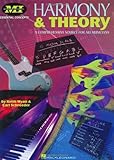
Harmony and Theory: A Comprehensive Source for All Musicians (Essential Concepts (Musicians Institute).)

  • ISBN13: 9780793579914
  • Condition: New
  • Notes: BUY WITH CONFIDENCE, Over one million books sold! 98% Positive feedback. Compare our books, prices and service to the competition. 100% Satisfaction Guaranteed

This book is a step-by-step guide to MI’s well-known Harmony and Theory class. It includes complete lessons and analysis of: intervals, rhythms, scales, chords, key signatures; transposition, chord inversions, key centers; harmonizing the major and minor scales; and more!

Rating: (out of 35 reviews)

List Price: $ 19.95

Price: $ 11.99

Find More Flash Tutorial Products

Comments

5 responses to “Harmony and Theory: A Comprehensive Source for All Musicians (Essential Concepts (Musicians Institute).)”

  1. Lewis Brownstein Avatar
    Lewis Brownstein

    Review by Lewis Brownstein for Harmony and Theory: A Comprehensive Source for All Musicians (Essential Concepts (Musicians Institute).)
    Rating:
    I had some music theory before I picked up this volume, but had not studied it in a comprehensive manner. This book took me through the basics in a step-by-step fashion. As a result, I feel I have a firm grasp of scale structure, intervals, and chord forms. The exercises (with answers in the back) are very useful and enable you to ensure that you have understood the text. I spent two weeks with this book this past summer and am delighted that I did. Strongly recommended.

  2. Maddi Hausmann Sojourner Avatar
    Maddi Hausmann Sojourner

    Review by Maddi Hausmann Sojourner for Harmony and Theory: A Comprehensive Source for All Musicians (Essential Concepts (Musicians Institute).)
    Rating:
    I spent 12 years studying classical piano and I have always had a good ear for music (which means I can’t sight-read …). When I went off to college, a group of people were jamming in the big room, so I sat down at the piano figuring I’d join in. Well, despite my thinking I was such a great ear-player I hadn’t the slightest idea what they were doing. It sounded like the 1-4-5 boogie woogie I learned in sixth grade, but it wasn’t. They told me to stop playing because I was doing it wrong, so I slinked off in humiliation.25 years later, my husband gave me this book. He was tired of having to explain what he thought was fairly standard chord notation, and I was frustrated that despite my years of study, I had no idea what he was talking about. I read the book through and I was back in that dorm social room… and I figured out what they were jamming on!!!!This book explained it all, chord substitutions, variations, which keys go with others and why, what works, what doesn’t, and what to call it so you can talk to other musicians. I realize the typical reader would be someone who can play but can’t read or write music, but don’t count yourself out just because you can. If, like me, you came from the classical world but never learned to talk rock or jazz theory, this is a great book for you. It really was a Rosetta Stone for me. And now I know what a flat-five substitution is and when to do it.

  3. Patrick D. Goonan Avatar
    Patrick D. Goonan

    Review by Patrick D. Goonan for Harmony and Theory: A Comprehensive Source for All Musicians (Essential Concepts (Musicians Institute).)
    Rating:
    I absolutely love this book. It covers essential music theory is a very short space in a well-organized manner. More importantly, it emphasizes the concepts that are most important to a musician who wants to develop their practical skills at chord substitution, improvisation, voicing chords, etc.

    Although the topics in this book are covered in academic books on harmony, they aren’t covered in such a powerful and concise way. Other books that targeted toward beginners don’t have the same depth. However, if you are a beginner, this book will be useful to you now and down the road. Therefore, don’t hesitate to buy it if you are just starting out.

    I have been playing the piano and other instruments for over 25 years and played in a band for 11 of those years. I often look at this book for review purposes and it is one of the few harmony books I have kept on my bookshelf. Another good one is HARMONY by Walter Piston. However, this volume is an excellent textbook, not a concise presentation of the key essentials.

  4.  Avatar
    Anonymous

    Review by for Harmony and Theory: A Comprehensive Source for All Musicians (Essential Concepts (Musicians Institute).)
    Rating:
    I know this subject — this book is in a class by itself… basic music theory isn’t that difficult… but explaining it is! The authors have actually gotten it right. They balance clarity thoroughness accuracy and practicality. This isn’t ‘rocket-science’ type theory, and it isn’t baby-stuff either… it’s directed at the musician who’s playing popular music (from blues and rock to sophisticated jazz) and who wants to understand basic notation, chords, fitting scales to chords for improvisation/soloing, modes, and chord substitutions. If it has a weak point it’s in explaining how chord progressions are put together, but in fairness that is a _huge_ subject… and this book is _great_ on everything else. Other books on this subject are typically miserable… this one even has excercises and an answer key. I’m reccommending it to all my guitar students… this book is an answered prayer.

  5. Dave Avatar
    Dave

    Review by Dave for Harmony and Theory: A Comprehensive Source for All Musicians (Essential Concepts (Musicians Institute).)
    Rating:
    This book gives you the “nuts and bolts” of music theory using a logical format, and content that is presented in an easy to understand manner – even for beginners. I highly recommend it. If you are intimidated by the thought of learning music theory (like I was) then you ought to consider this book. There are plenty of written excercises contained in each chapter to help make sure you understand the concepts presented (and the answers are in the back of the book). In essence, each short chapter offers an opportunity to gain a sense of accomplishment before you move on to the next concept. Even my favorite music teacher, who has over 35 years of teaching under her belt, was thoroughly impressed with this book and plans to buy a copy for herself. By the way, this is the book used for a music theory class at Musician’s Institute in Southern California (a music performance school).

Leave a Reply

Your email address will not be published. Required fields are marked *